


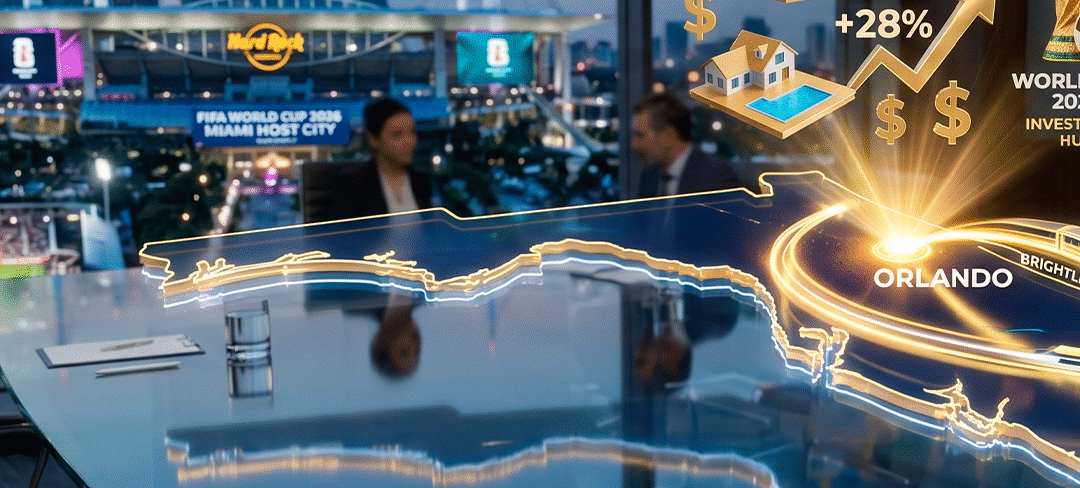
The Florida Ecosystem: Miami and Orlando, the Two Sides of Real Estate Investment During the 2026 World Cup
With the World Cup in full swing, the real estate market proves that the success of mega-events is not limited to a single city, but relies on a connected regional strategy.
With the 2026 FIFA World Cup officially underway, the economic landscape of the United States is experiencing an unprecedented transformation. For global real estate investors, the projections are highly compelling: globally, the expanded 48-team tournament is expected to draw approximately 6.5 million attendees. Locally, Miami-Dade County alone projects up to 1 million visitors, generating an estimated economic impact of $1.3 billion for South Florida.
Faced with this historic influx of capital and tourism, smart investment strategies in Florida must evolve. It is no longer about picking a single dot on the map; it is about leveraging a dual and diversified investment ecosystem. Building a portfolio that encompasses the state's two most dynamic markets—Miami and the Greater Orlando area—allows investors to tailor their assets to different risk and return profiles.
Miami: The Direct Epicenter and High-Profile Appreciation
For investors whose primary goal is to capitalize on immediate global visibility and long-term capital appreciation, the Miami market is the most direct play. Hosting seven official World Cup matches, the city experiences a unique and powerful magnetism.
- Corporate and Luxury Demand: Miami attracts global sponsors, international media, and high-net-worth tourists who demand premium accommodations and luxury rentals.
- Capital Appreciation: Investing in South Florida means positioning capital in a high-appreciation market, where real estate assets benefit directly from local infrastructure injections and the prestige of being a central host city.
Greater Orlando: The Hospitality Engine and Cash Flow Generator
The economic impact of the World Cup extends far beyond a 90-minute match. Hundreds of thousands of families and international groups naturally extend their trips to visit the theme park capital of the world. This is where the Greater Orlando area dominates short-term profitability.
- The Compression Effect: Traditional hospitality in South Florida quickly reaches maximum capacity during mega-events. The Short-Term Rental market across Orlando's vacation corridors offers the scalability that large traveling groups demand.
- Format and Amenities: Large-scale vacation homes (ranging from 4 to 10+ bedrooms) located within resort-style communities absorb this massive demand. This allows property owners to aggressively optimize their Average Daily Rates (ADR) and secure extraordinary Cash Flow.
The Connecting Artery: The Brightline Effect
What truly unites these two strategies—and transforms Florida into a single, powerhouse investment hub—is modern transportation infrastructure. The Brightline high-speed rail now allows tourists to soak in the energy of a match in Miami and travel seamlessly to their spacious vacation homes in the Orlando area in under three hours.
This connectivity erases geographic barriers, funneling the global economic spillover from the southern host city directly into Central Florida's hospitality engine.
What is the Ideal Strategy for Your Portfolio?
The 2026 World Cup is a historic milestone, but the expansion and maturation of Florida's real estate market is a long-term structural phenomenon. By having access to strategic inventory in both Miami and Greater Orlando, the key is not to force a single property purchase, but to structure the financial play that best aligns with your wealth preservation and income goals.
Diversify Your U.S. Investment Portfolio
Explore our exclusive portfolio in Miami and Orlando. Discover which market offers the best profitability and appreciation projections based on your investor profile.
* Complimentary consultation focused on data analysis and Real Estate strategies.
Recent Comments